



Machine Learning

- Featured Courses
- 2 components
- All Levels
- 0 Rating
- 0 Reviews
This courselet explores whether semantic information extracted from Ai...
Machine Learning Courses/Courselets
- 1
- 2 Students
- All Levels
Courselet
The next-word task from n-gram counts through attention and pre-training to decoding, fine-tuning and RLHF
- 0 Reviews
What you will learn
- Compute the information content of a word as minus log2 of its probability given the context, and the entropy of a predi...
- Compare n-grams, RNNs, sequence-to-sequence models and the transformer as solutions of one prediction task
- Describe pre-training with BERT and GPT, scaling laws, byte pair tokenization, decoding and the RLHF objective
- 1
- 0 Students
- All Levels
Courselet
Six notebooks from n-gram models to BERT and GPT pre-training, each at an easy, an intermediate and an expert level
- 0 Reviews
What you will learn
- Build n-gram, neural embedding, RNN, LSTM and sequence-to-sequence next-word predictors in Python
- Evaluate language models with perplexity and translation models with BLEU
- Contrast the masked language modeling objective of BERT with the causal objective of GPT
- 2
- 2 Students
- All Levels
Courselet
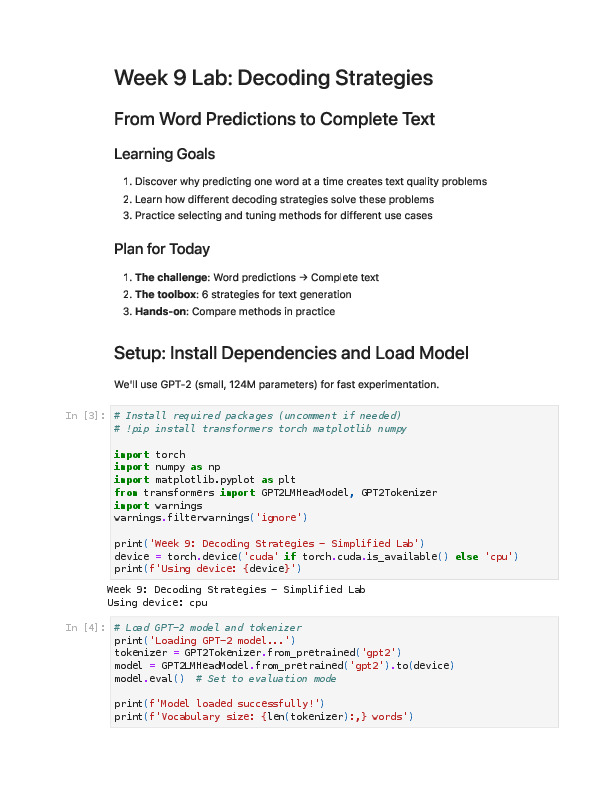
GPT-2 small experiments with greedy, beam, temperature, top-k and nucleus decoding and measures of diversity
- 0 Reviews
What you will learn
- Implement greedy decoding, beam search, temperature sampling, top-k sampling and nucleus sampling for GPT-2 small
- Measure diversity with distinct-n and count repeated n-grams in generated text
- Test how temperature, k and p change diversity and choose a method for a given task
- 2
- 1 Students
- All Levels
Courselet
Greedy, beam, temperature, top-k, nucleus and contrastive search, matched to six problems of generated text
- 0 Reviews
What you will learn
- Compute temperature-scaled softmax probabilities for a vector of logits
- Apply top-k and nucleus filtering to a probability distribution and explain why the size of the nucleus depends on the s...
- Select a decoding method and its parameters for translation, factual answers, code, dialogue and long stories
- 1
- 3 Students
- All Levels
Courselet
Neurons, activation functions, layers, forward propagation and gradient descent, applied to market prediction
- 0 Reviews
What you will learn
- Compute the output of a neuron as a weighted sum followed by a sigmoid activation
- Explain why one neuron cannot solve the XOR problem and how hidden layers give curved decision boundaries
- Describe training by gradient descent and judge a classifier by accuracy, precision, recall and F1
- 2
- 1 Students
- All Levels
Courselet
This is a presentation corresponding to the paper https://arxiv.org/abs/2503.16753
- Free
- 0 Reviews
- 2
- 3 Students
- All Levels
Courselet
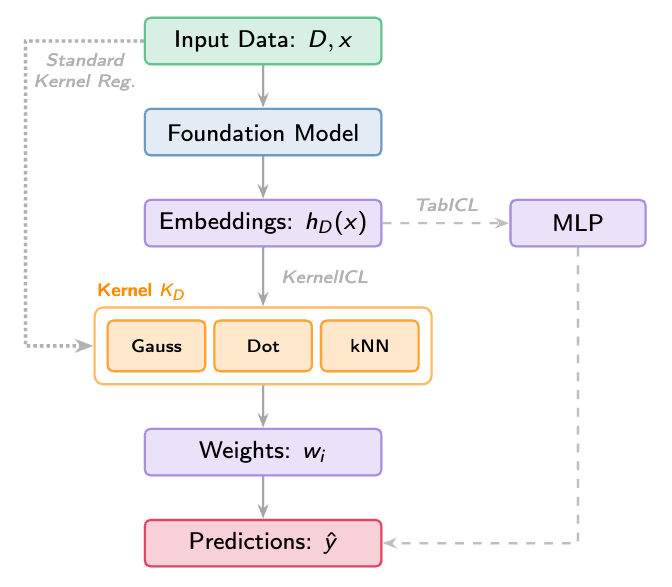
Kernel smoothing for foundational models: https://arxiv.org/abs/2602.02162
- Free
- 0 Reviews
- 2
- 24 Students
- All Levels
Courselet
This courselet explores whether semantic information extracted from Airbnb guest reviews can improve price prediction for Ber..
- Free
- 0 Reviews
What you will learn
- Use reviews as data - See how guest reviews can add useful signals for Airbnb price prediction.
- Prepare review text - Clean, anonymise and split multilingual reviews into sentence-level data.
- Find recurring topics - Use embeddings, UMAP and BERTopic to group similar review sentences into topics.
- Measure topic sentiment - Analyse whether guests talk positively or negatively about each topic.

- 1
- 4 Students
- All Levels
Courselet
Next-word prediction from n-gram counts to transformers, scaling laws, prompting and safety, in four hours
- 0 Reviews
What you will learn
- Compute n-gram probabilities with smoothing and evaluate a language model by perplexity.
- Trace the path from recurrent networks and LSTM gates to scaled dot-product attention and the transformer, including a t...
- Compare pre-training, prompting, retrieval, fine-tuning and RLHF, and sampling by temperature, top-k and nucleus.

- 0
- 2 Students
- All Levels
Course
Next-word prediction from n-gram counts to the encoder-decoder transformer
- 0 Reviews
What you will learn
- Compute n-gram probabilities with smoothing and evaluate language models by perplexity.
- Explain recurrent networks, LSTM gates, attention and the encoder-decoder transformer as steps of one development.
- Compare pre-training, scaling, prompting, retrieval, fine-tuning and alignment as ways to build and adapt language model...