



Machine Learning
Machine Learning Courses/Courselets
- 2
- 3 Students
- All Levels
Courselet
N-gram language models, smoothing and perplexity, with a counting lab
- 0 Reviews
What you will learn
- State next-word prediction formally and derive the chain rule of probability.
- Compute bigram and trigram probabilities by counting, and explain why smoothing is needed under data sparsity.
- Evaluate a language model by perplexity, equal to 2 to the power of the entropy.
- 2
- 2 Students
- All Levels
Courselet
Recurrent networks, LSTM gates, attention and the transformer as answers to the limits of n-grams
- 0 Reviews
What you will learn
- Write the recurrence of an RNN and explain the vanishing gradient problem.
- Describe the forget, input and output gates of an LSTM and the reduction of the vanishing gradient by an additive cell s...
- Compute scaled dot-product attention from queries, keys and values, and describe multi-head attention and positional enc...
- 2
- 2 Students
- All Levels
Courselet
Pre-training, BERT and GPT, scaling laws, reasoning at answer time and tokenisation
- 0 Reviews
What you will learn
- Contrast the bidirectional masking of BERT with the causal masking of GPT.
- State the power-law form of the scaling laws and the shift from training compute to compute at answer time.
- Apply byte pair encoding merges to a small corpus and estimate the memory of a training run at about 20 bytes per parame...
- 2
- 2 Students
- All Levels
Courselet
Fine-tuning, prompting, retrieval, alignment and agent safety, with a sonnet lab
- 0 Reviews
What you will learn
- Choose between fine-tuning and prompting for a given adaptation problem.
- Apply chain-of-thought prompting and explain temperature, top-k and nucleus sampling.
- Describe retrieval-augmented generation, the three steps of RLHF and the safety risks of agents.
- 3
- 2 Students
- All Levels
Courselet
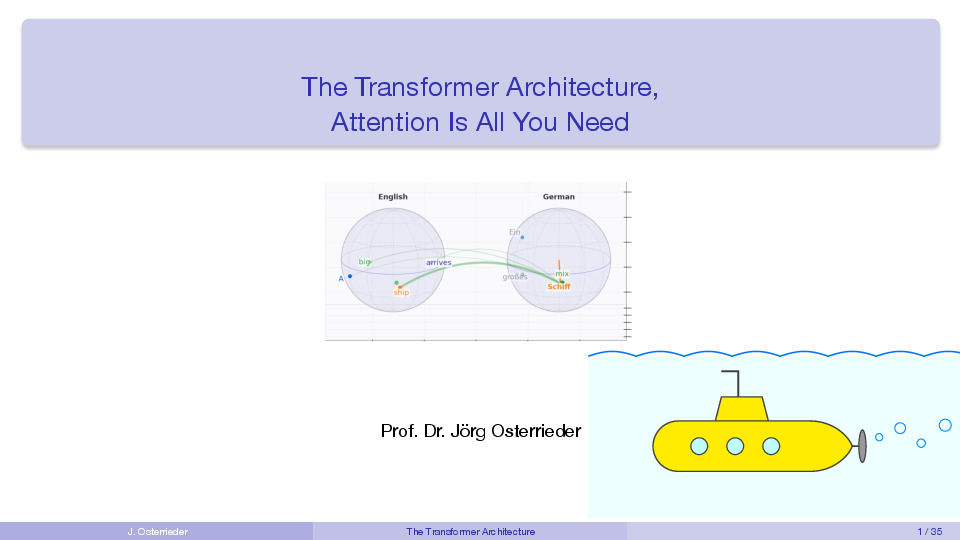
Encoder-decoder of 2017 with attention, seven elements, one layer in two equations
- 0 Reviews
What you will learn
- Write a transformer language model as a product of next-token softmax distributions.
- Name the seven elements of the encoder-decoder transformer of 2017 and place them in four groups.
- Compute scaled dot-product attention as a softmax-weighted sum of value rows, and write one encoder layer in two equatio...
- 2
- 1 Students
- All Levels
Courselet
The chain rule, entropy and n-gram counts, from Shannon's 1951 guessing game to GPT-2
- Free
- 0 Reviews
What you will learn
- Write the probability of a word sequence as a product of next-word probabilities with the chain rule.
- Compute entropy in bits, including 1.58 bits for three equally likely words and 4.75 bits for 27 equal symbols.
- State why an unseen phrase has probability zero in a trigram model and why "dog" and "puppy" are unrelated entries in a...
- 1
- 1 Students
- All Levels
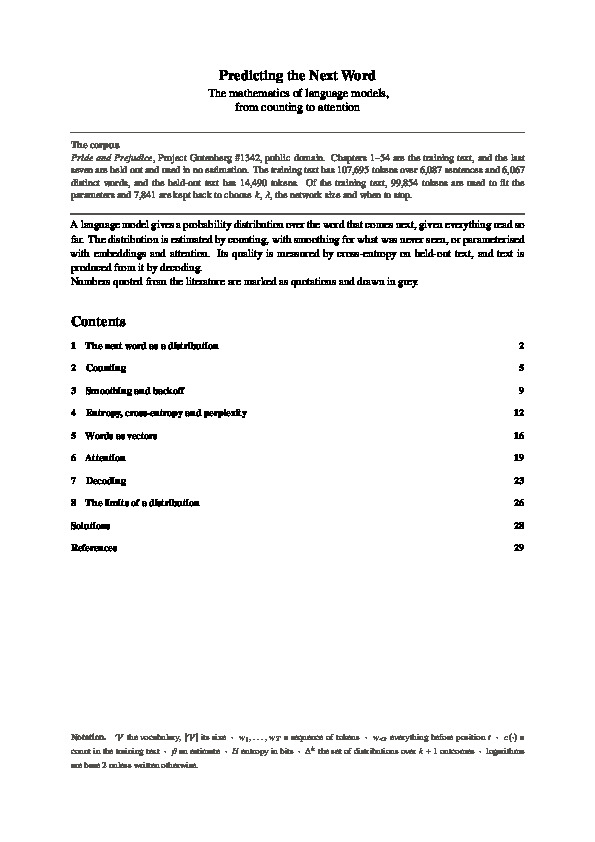
Courselet
Counting, smoothing, entropy, word vectors, attention and decoding on one novel
- Free
- 0 Reviews
What you will learn
- Compute the probability and the bits of a sentence from bigram counts with the chain rule.
- Derive cross-entropy as the sum of entropy and KL divergence and read perplexity as an effective number of choices.
- Explain why attention scores are divided by the square root of the head width and how a next-word distribution changes w...
- 2
- 1 Students
- All Levels
Courselet
Chain rule, maximum likelihood, entropy, KL divergence, perplexity and gradient descent
- Free
- 0 Reviews
What you will learn
- Decompose the probability of a sentence with the chain rule and estimate each factor by maximum likelihood.
- Compute entropy, cross-entropy and KL divergence in bits, such as 0.531 bits for P = (0.9, 0.1) against Q = (0.5, 0.5).
- Convert a loss of 3.91 nats into bits and a perplexity of 49.9, and state when two perplexities are comparable.
- 2
- 1 Students
- All Levels
Courselet
N-gram models on a toy corpus with add-k, Good-Turing, Kneser-Ney and perplexity
- Free
- 0 Reviews
What you will learn
- Build a bigram model from counts on a four-sentence corpus and check that every row sums to one.
- Apply add-k, Good-Turing, Kneser-Ney and interpolation to unseen n-grams and compare their trade-offs.
- Compute a perplexity from a total log probability and state when two perplexities are comparable.
- 2
- 1 Students
- All Levels
Courselet
One-hot vectors, co-occurrence counts, skip-gram, GloVe and FastText with worked numbers
- Free
- 0 Reviews
What you will learn
- Compute the cosine of two rows of co-occurrence counts and rank words by it.
- Compute one skip-gram training step with negative sampling from a real pair and a noise pair.
- Count the skip-gram pairs of a sentence and the vectors that are summed for a word in FastText.