



Chapter 1: Regression Models (Slides) (pdf)
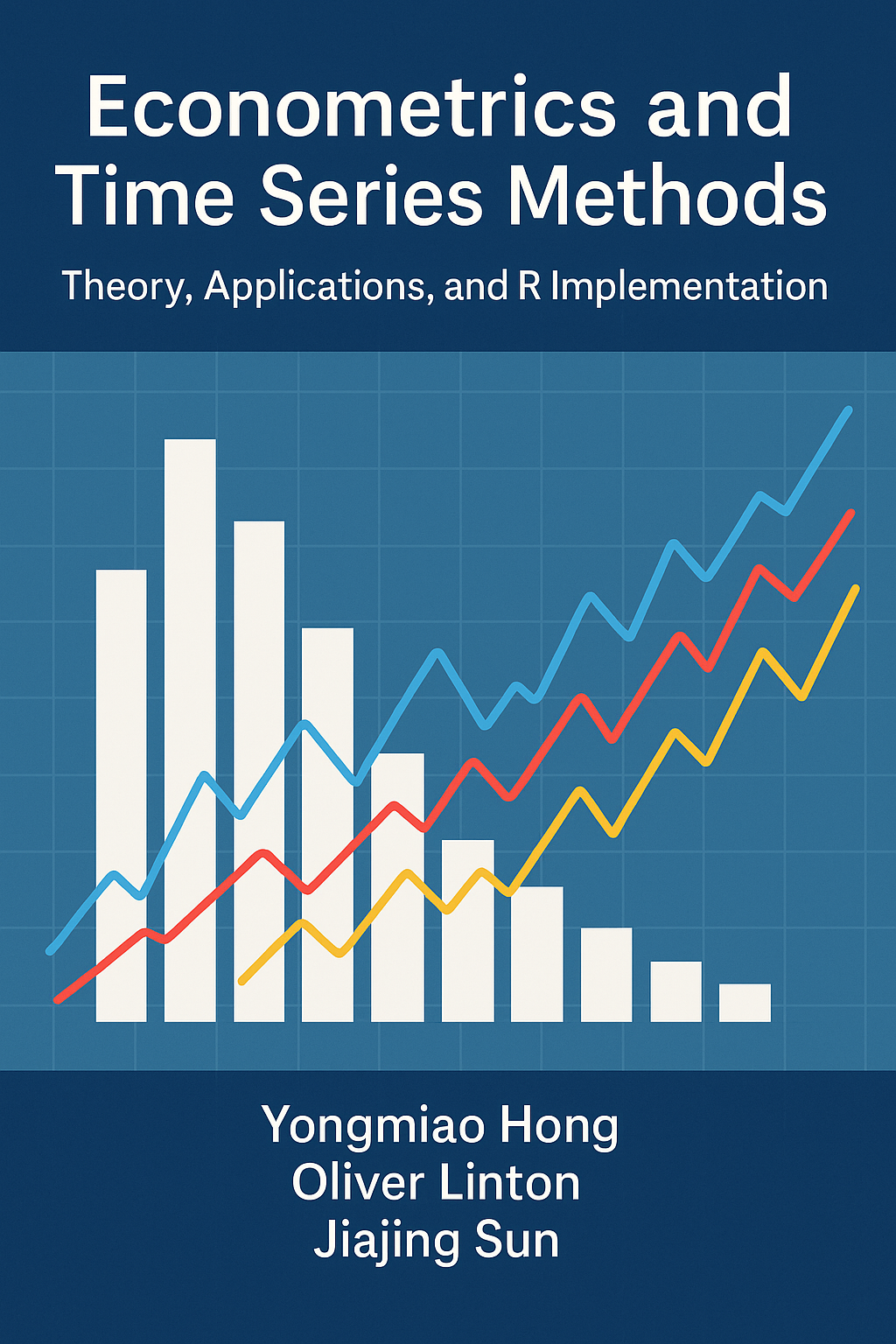
Econometrics and Time Series Methods Theory, Applications, and R Implementation
-
- 0 Rating
- 0 Reviews
- 59 Students Enrolled
Econometrics and Time Series Methods Theory, Applications, and R Implementation
Free companion course for Econometrics and Time Series Methods: Theory, Applications, and R Implementation by Yongmiao Hong, Oliver Linton, and Jiajing Sun. Ten chapter modules bring together full English video lectures, protected downloadable slides, and reproducible R materials, spanning regression, time series, volatility, nonparametric methods, HAR inference, filtering, nonstationarity, continuous-time finance, and selected machine learning tools. Companion website: https://econometricsandtimeseries.com/
-
- 0 Rating
- 0 Reviews
- 59 Students Enrolled
Course Content
10 courselets
|
|
997 K | |
|
Chapter 1: Regression Models (Slides) (video)
|
62 min |
|
Chapter 2: Univariate Time Series (pdf)
|
2.16 M | |
|
Chapter 2: Univariate Time Series (video)
|
77 min |
|
Chapter 3: Multivariate Linear Time Series (Slides) (pdf)
|
804.7 K | |
|
Chapter 3: Multivariate Linear Time Series (Slides) (video)
|
60 min |
|
Chapter 4: Volatility Models (Slides) (pdf)
|
535.52 K | |
|
Chapter 4: Volatility Models (Slides) (video)
|
75 min |
|
Chapter 5: Nonparametric Methods (Slides) (pdf)
|
1.12 M | |
|
Chapter 5: Nonparametric Methods (Slides) (video)
|
52 min |
|
Chapter 6: Heteroskedasticity and Autocorrelation Robust (HAR) Inference (Slides) (pdf)
|
915.1 K | |
|
Chapter 6: Heteroskedasticity and Autocorrelation Robust (HAR) Inference (Slides) (video)
|
76 min |
|
Chapter 7: Filtering (Slides) (pdf)
|
811.62 K | |
|
Chapter 7: Filtering (Slides) (video)
|
50 min |
|
Chapter 8: Nonstationary Processes (Slides) (pdf)
|
1.96 M | |
|
Chapter 8: Nonstationary Processes (Slides) (video)
|
61 min |
|
Chapter 9: Continuous-Time Finance (Slides) (pdf)
|
681.23 K | |
|
Chapter 9: Continuous-Time Finance (Slides) (video)
|
70 min |
|
Chapter 10: Selected Machine Learning Tools for Econometrics in R (Slides) (pdf)
|
550.87 K | |
|
Chapter 10: Selected Machine Learning Tools for Econometrics in R (Slides) (video)
|
49 min |
Requirements
- • Solid background in calculus and linear algebra • Introductory probability and statistics • Basic undergraduate econometrics (regression) • Working knowledge of R (or willingness to learn while following the examples)
General Overview
Description
This course accompanies the book
Yongmiao Hong, Oliver Linton, Jiajing Sun
Econometrics and Time Series Methods: Theory, Applications, and R Implementation.
It provides slides and R code for a ten-chapter sequence in econometrics and time series, suitable for advanced undergraduate and graduate students. The course emphasizes dynamic econometrics, links formal theory to empirical applications, and integrates implementation in R throughout.
Course structure (modules / chapters):
1. Regression Models
A structured introduction to regression models and the classical linear regression framework. Topics include model specification, interpretation of coefficients, Gauss–Markov assumptions, finite-sample and asymptotic properties of the OLS estimator, hypothesis testing, and goodness-of-fit measures, with R-based examples.
2. Univariate Time Series
Foundations of univariate time series analysis: time series data structures, stochastic processes, stationarity, autocovariance and autocorrelation functions, and linear AR, MA, and ARMA models, including identification, estimation, forecasting, and diagnostic checking in R.
3. Multivariate Linear Time Series
Analysis of multiple time series evolving jointly over time. Topics include vector-valued stochastic processes, second-order properties of multivariate time series, VAR/VMA/VARMA models, stability and stationarity, impulse–response analysis, and multivariate forecasting, with R implementations.
4. Volatility Models
Modeling and forecasting time-varying volatility, especially for financial time series. Covers empirical features such as volatility clustering and leverage effects; ARCH/GARCH-type models and extensions; conditional variance dynamics; estimation, diagnostics, and volatility forecasting in R, with applications in risk management and asset pricing.
5. Nonparametric Methods
Nonparametric econometric and time series methods when functional forms are left flexible. Includes nonparametric regression, kernel smoothing, bandwidth selection, local polynomial methods, and estimation of conditional moments and distributions, with a focus on uncovering nonlinearities and structural changes using R.
6. Heteroskedasticity and Autocorrelation Robust (HAR) Inference
Inference in regression and time series models with heteroskedastic and/or serially correlated errors. Topics include heteroskedasticity-robust and HAC covariance estimators, long-run variance estimation, bandwidth and kernel choices, and robust t- and Wald-type tests. R examples show how HAR methods modify standard regression output and inference.
7. Filtering
State–space modeling and filtering methods for extracting latent signals from noisy observations. Covers state and observation equations, the Kalman filter, filtering, smoothing, and prediction, as well as initialization issues and missing data. R implementations illustrate state–space specification, filtering and smoothing, and interpretation of latent components.
8. Nonstationary Processes
Nonstationary time series whose properties evolve over time, including deterministic and stochastic trends, random walks, unit roots, and trend- vs difference-stationary models. The course discusses spurious regression, appropriate transformations, and unit root testing, with practical R tools for diagnosing and handling nonstationarity.
9. Continuous-Time Finance
Continuous-time models for asset prices and interest rates based on stochastic calculus and diffusion processes. Topics include Brownian motion, stochastic differential equations, Itô’s lemma, geometric Brownian motion, martingale and no-arbitrage principles, risk-neutral valuation, and benchmark pricing results such as Black–Scholes, with simulation and implementation in R.
10. Selected Machine Learning Tools for Econometrics in R
An applied introduction to machine learning tools that complement econometric modeling. Topics include regularized regression (ridge, lasso, SCAD), tree-based methods, model selection and cross-validation, and prediction-focused evaluation. Examples show how to fit, tune, and interpret these models in an econometric forecasting workflow using R.
Unless otherwise indicated, the slides are shared under the Creative Commons Attribution–NonCommercial 4.0 International License (CC BY-NC 4.0). Readers and instructors who wish to request the LaTeX source files or provide feedback are welcome to contact us at jiajing.sun@gmail.com.
Recommended for you



Meet the instructors !
