



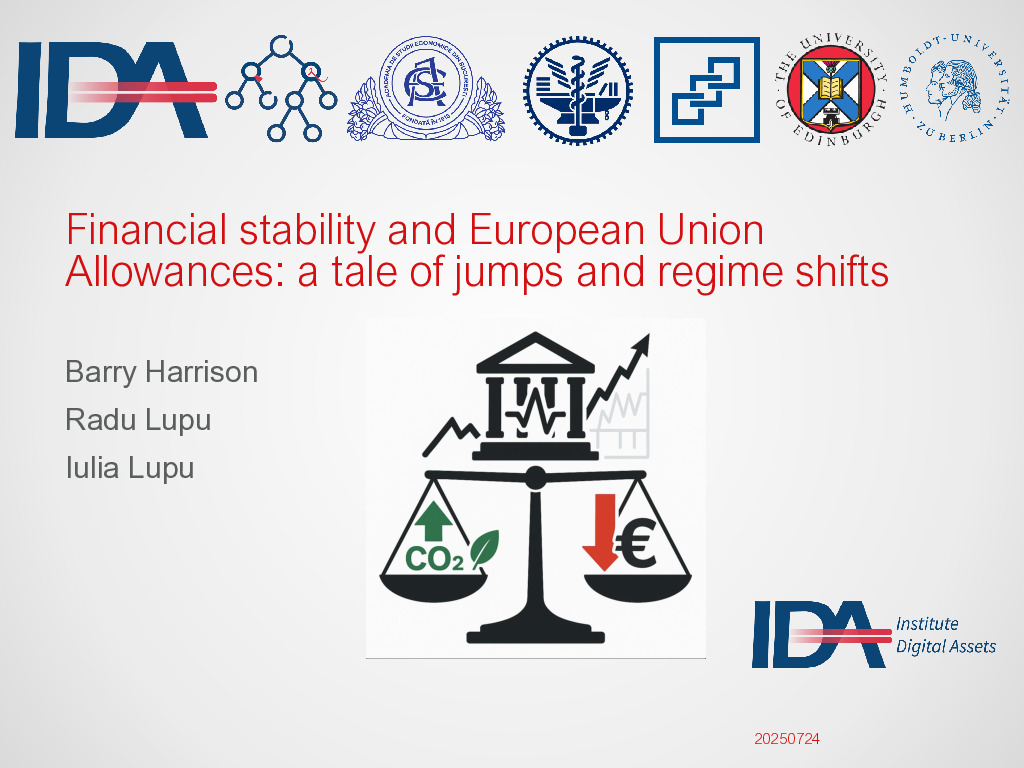
Financial stability and European Union Allowances: a tale of jumps and regime shifts
-
- 0 Rating
- 0 Reviews
- 1 Students Enrolled
Financial stability and European Union Allowances: a tale of jumps and regime shifts
This short course walks the audience through an insightful investigation into how the carbon market—specifically the European Union Allowances (EUA)—influences financial stability in the banking sector.
-
- 0 Rating
- 0 Reviews
- 1 Students Enrolled
Requirements
- Statistics, Event study
General Overview
Description
Based on a paper published in Applied Economics Letters (2024), the presentation blends financial econometrics, environmental economics, and systemic risk analysis into a coherent, accessible storyline.
Objective:
Participants will explore the main empirical findings of the paper, focusing on how sudden movements (jumps) and structural breaks (regime shifts) in the EUA market affect systemic risk for European banks. The course provides a concise and rigorous exposition of the methodologies used, such as jump detection, regime shift modeling using generalized additive models, and event studies with financial risk indicators (CoVaR, ΔCoVaR, MES).
Structure:
-
Motivation: Why climate policy and carbon markets matter for financial stability.
-
Methodology: How jumps and shifts are detected, and how systemic risk is measured.
-
Empirical Results: What happens to financial risk when carbon prices surge or drop.
-
Discussion: Implications for policy, banking risk management, and future research.
Takeaways:
-
Understand the event-study framework applied to climate-finance data.
-
Learn how systemic risk reacts differently to positive and negative EUA shocks.
-
Discover the policy relevance of integrating environmental dynamics into financial risk modeling.
Target Audience:
Economics students, financial analysts, sustainability policymakers, and anyone interested in the intersection of climate policy and financial risk.
Recommended for you

Meet the instructors !
I am part of the IDA team and would like to be able to contribute to the quantinar platform. Thank you!